Crate Training Your Border Collie: 7 Step-by-Step Secrets for Success
Introduction to Crate Training Your Border Collie
Crate training your Border Collie might sound like a huge task, but it is honestly one of the absolute best things you can do for your brilliant new best friend. If you’ve spent even five minutes with one of these pups, you already know they are basically the geniuses of the dog world—super smart, athletic, and bursting with energy. Because they are bred to work all day, their brains are almost always “on.” But just like us after a long day of school or studying, their incredibly active minds seriously need a quiet place to physically and mentally unwind.
Here is the problem: without proper boundaries or a designated safe space, a bored or overstimulated Border Collie can easily become anxious or start destructive behaviors (say goodbye to your favorite sneakers!). That is exactly why having a structured space is so important. A lot of people worry that a dog crate looks like a cage, but you have to reframe how you think about it. According to the experts, a crate actually mimics a cozy, natural “den” that appeals directly to a dog’s wild instincts to seek out small, protective shelters.
When it’s introduced the right way, a crate goes from being a scary box to their favorite personal hangout spot. Ready to get started? Let’s dive into the 7 step-by-step secrets to making crate training your Border Collie a totally positive, stress-free experience for both you and your dog!
Secret 1: Select the Perfect Crate Size and Type
When it comes to picking out the actual crate, you want to follow the “Goldilocks Rule”—it needs to be just right. If the dog crate is way too big, your clever Border Collie might decide to use one comfy corner as a bedroom and the opposite corner as an indoor bathroom (yuck!). If it’s too small, they’ll feel cramped and miserable.
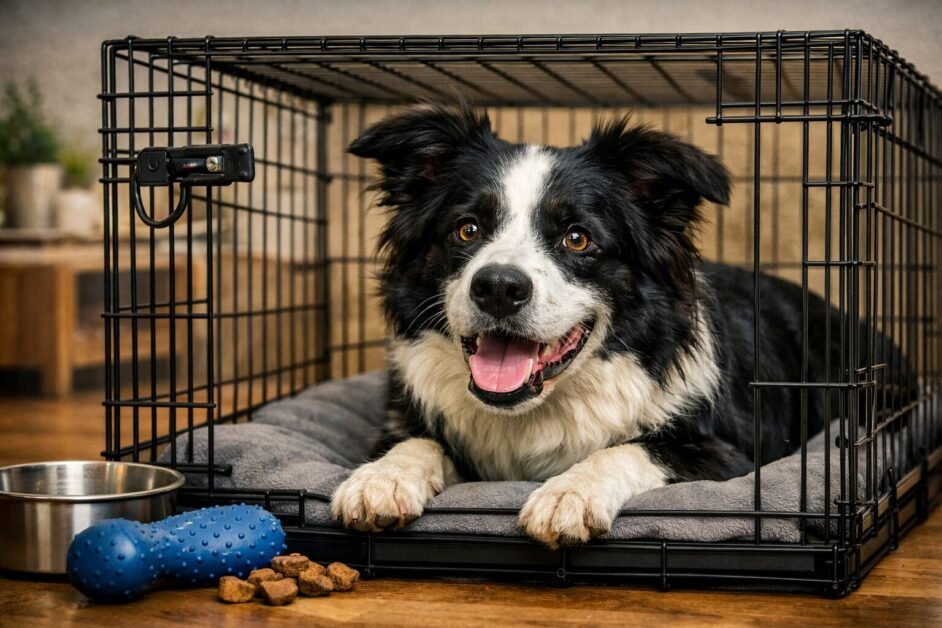
The perfect fit means the crate is just big enough for your dog to stand up fully without hitting their head, turn around completely, and lie down comfortably. If you’re currently crate training a puppy, don’t panic—you don’t have to drop cash on a brand-new crate every single month. Many wire crates come with super handy divider panels so you can expand the space as your dog grows. The Humane Society highly recommends this sizing strategy, especially since it makes house training so much easier!
Next, you have to choose between the two main styles: wire crates and plastic enclosed crates. For a Border Collie, a wire crate is usually the ultimate winner. They offer amazing airflow (which is super important for a dog with a thick, fluffy double coat) and let your extremely observant pup see exactly what’s going on around the house. Plus, you can easily drape a blanket over the top and sides to make it feel like a darker, cozier den when it’s time to sleep. Plastic crates are also a solid option and are required if you ever plan on flying with your dog, but they can sometimes get a little too warm for a full-coated collie.
Secret 2: Pick the Ideal Location
Where you decide to set up the crate is actually a huge deal. Border Collies are incredibly social animals—some people even call them “Velcro dogs” because they always want to be stuck right by your side! If you take their new dog crate and shove it in a dark, empty basement or an isolated laundry room, they are going to feel like they are being punished or missing out on all the action.
During the day, you definitely want to place the crate in a family-centric area, like the corner of your living room or near the kitchen. This way, your pup can safely chill out while still feeling like they are part of the pack. They can watch you do homework or hang out with the family without being right in the middle of the chaos. Proper crate placement is a massive step in successful puppy training because it teaches them how to relax around normal household noise.
When nighttime rolls around, things change a bit. Especially during the early stages, it is a great idea to move the crate into your bedroom (or even just pick up a second, cheaper wire crate for sleeping). According to the experts at the American Kennel Club, bringing the crate into your bedroom at night gives your puppy a sense of security and keeps them from feeling abandoned. They can hear you breathing, smell that you are close by, and feel safe enough to finally drift off to sleep without panicking.
Secret 3: Master the “Open Door” Introduction
Now that you have the perfect spot picked out, it’s time for the very first step of crate training your Border Collie! This is where a lot of people mess up by rushing things. The golden rule here is to let your Border Collie explore their new room entirely on their own terms.
Start by making the crate look incredibly inviting. Toss in some soft bedding, maybe an old t-shirt that smells like you, and just leave the door wide open. According to the Humane Society’s crate training guide, you should never, ever force or shove your dog inside. Doing that will instantly terrify them and make them hate the space before they even get to know it.
Instead, just hang out near the crate and ignore it for a bit. Because Border Collies are naturally curious and love to investigate new things, they will eventually wander over to sniff it. When they do, softly praise them. You can even casually drop a few pieces of kibble or small treats near the entrance, and then slowly toss them further inside. If they only put two paws in, stretch their neck to grab the treat, and then immediately back out—that is totally fine! The goal right now is just to build up their confidence and show them that the dog crate is a safe, completely stress-free zone.
Secret 4: Utilize High-Value, Crate-Only Treats
Now for the fun part—the snacks! Border Collies are super smart and quickly figure out patterns, which makes this next secret a total game-changer for puppy training. It is all about a cool psychological trick: reserving the absolute best, most mouth-watering treats exclusively for crate time.
We are talking about the high-value stuff here. Plain kibble is fine for everyday tricks, but to make the dog crate irresistible, you want to bring out the big guns. Think pieces of boiled chicken, small cubes of dog-safe cheese, or a heavy-duty chew. A massive favorite among dog owners is using a classic KONG toy. The experts at the American Kennel Club highly recommend stuffing a toy with something delicious like peanut butter (always double-check that it is xylitol-free!) and giving it to them the second they step inside.
Why does this work so well? Because it builds a super strong, positive association in your dog’s brain. If your Border Collie realizes that the only time they ever get that amazing peanut butter treat is when they step inside their crate, they are going to start running in there on their own. They basically stop seeing it as a boring enclosure and start viewing it as a magical treat dispenser!
Secret 5: Transition to Crate-Based Meal Times
Let’s be real—if there is one thing a Border Collie loves as much as running and playing, it is dinnertime! Secret number five of crate training your Border Collie takes full advantage of their appetite to make puppy training way easier. By transitioning to crate-based meal times, you are reinforcing the idea that the absolute best parts of the day happen right inside their dog crate.
If your pup is still a little nervous about stepping all the way in, do not just shove their bowl to the very back. You want to take it slow! Start by placing their food dish just outside the entrance or right inside the open door. If they are cool with that and eat without hesitation, move the bowl a few inches further back with each new meal.
Eventually, they will be standing all the way inside to reach their food. According to the American Kennel Club’s guide to crate training, once your dog is comfortably eating their meals entirely inside the crate, you can take the next big step: closing the door while they are munching away. At first, you should open the door the very second they finish eating so they don’t feel trapped. With every meal, you can leave the door closed for just a few minutes longer, teaching them that hanging out in there is no big deal!
Secret 6: Practice the “Incremental Time” Method
Now that your Border Collie is comfortable walking in and grabbing treats, it’s time to start closing the door for short periods. This is where many owners accidentally move too fast, so patience is your best friend here! You want to teach your pup that being in the crate with the door closed is totally normal and actually pretty relaxing.
Start by giving your dog a distraction, like a treat or a chew toy, and gently close the door. Keep it closed for just a few seconds while you stay right there, maybe talking to them in a calm voice. Before your dog has a chance to get impatient, whine, or scratch at the door, open it up. You want to open the door before they feel the need to ask to be let out. This teaches them that you are the one in control, and that they are perfectly safe waiting for you to come back.
As they get better at this, you can gradually increase the time to a few minutes, then ten minutes, and eventually, they will be able to hang out in there for longer stretches while you’re busy around the house. The experts at the Humane Society suggest that if your dog starts to whine or cry, you might have moved too quickly. If that happens, don’t scold them—just step back a bit to the previous level of time that they were comfortable with and build up again more slowly. Remember, your Border Collie wants to please you; they just need to learn that “crate time” equals “chill time.”
Secret 7: Protect the Crate as a Punishment-Free Zone
This is the absolute golden rule of crate training your Border Collie, and it is the one you must never break: never, under any circumstances, use the crate as a punishment or a “time-out” space when you are angry.
If you send your Border Collie to their crate because they chewed a shoe or had an accident on the carpet, you are essentially poisoning their sanctuary. Instead of seeing the crate as their cozy “den,” they will start to view it as a place where they go when you are upset. This can lead to your dog becoming afraid of the crate, which defeats the entire purpose of all the hard work you’ve put in so far.
For your Border Collie to truly love their crate, it must remain their absolute safest, happiest spot in the house. The experts at the American Kennel Club emphasize that the crate should always be your dog’s personal happy place. If your dog is acting out and you need a moment to calm down, it is much better to put them in a puppy-proofed room or an exercise pen while you take a breather. Keep the crate experience purely positive, filled with rewards and relaxation, and you will have a pup who actually wants to settle down and rest.
Conclusion
Crate training your Border Collie might feel like a big project right now, but remember that you are building the foundation for a much calmer, happier, and more secure Border Collie. These dogs are incredibly intelligent and they crave structure; by giving them a space of their own, you aren’t just “training” them—you are giving them a sanctuary where they can mentally switch off from the world.
Consistency and patience are the most important tools in your kit. There will be days when your pup resists or when you feel like you aren’t making progress, but stay the course. By keeping the experiences positive and following these seven secrets, you will soon have a pup who trots into their crate willingly for a nap or a chew session. You are setting your Border Collie up for a lifetime of success, and that is a pretty great feeling!
Quick Reference: The 7 Secrets to Success
| Secret | Topic | Key Takeaway |
|---|---|---|
| 1 | Select the Perfect Crate | Use the "Goldilocks Rule"—just big enough to stand, turn, and lie down. |
| 2 | Pick the Ideal Location | Place it where the family hangs out to keep them social. |
| 3 | Open Door" Intro | Let them explore on their terms; never force them inside. |
| 4 | High-Value Treats | Only give the best snacks (like frozen Kongs) inside the crate. |
| 5 | Crate-Based Meals | Feed them inside to create a positive association. |
| 6 | Incremental Time | Practice closing the door for short periods and build up slowly. |
| 7 | No Punishment Zone | Never use the crate as a "time-out" or a punishment. |
Frequently Asked Questions
Q: My puppy whines the second I close the door. What should I do?
A: It’s super tempting to run back to them, but wait a moment. If they are just fussing to get out, try to wait for a brief lull in the whining before you open the door. If you open it while they are making noise, you’re accidentally teaching them that "whining = freedom." If they are genuinely panicked, slow down your training steps and keep the door open for a few more days before trying to close it again.
Q: Is crate training considered cruel?
A: When done correctly, absolutely not. Dogs are den animals by nature, and they often seek out small, cozy spaces to feel safe. According to The Humane Society of the United States, if the crate is introduced as a safe, positive haven rather than a cage for confinement, most dogs eventually learn to love their crate and will retreat there on their own when they want to relax.