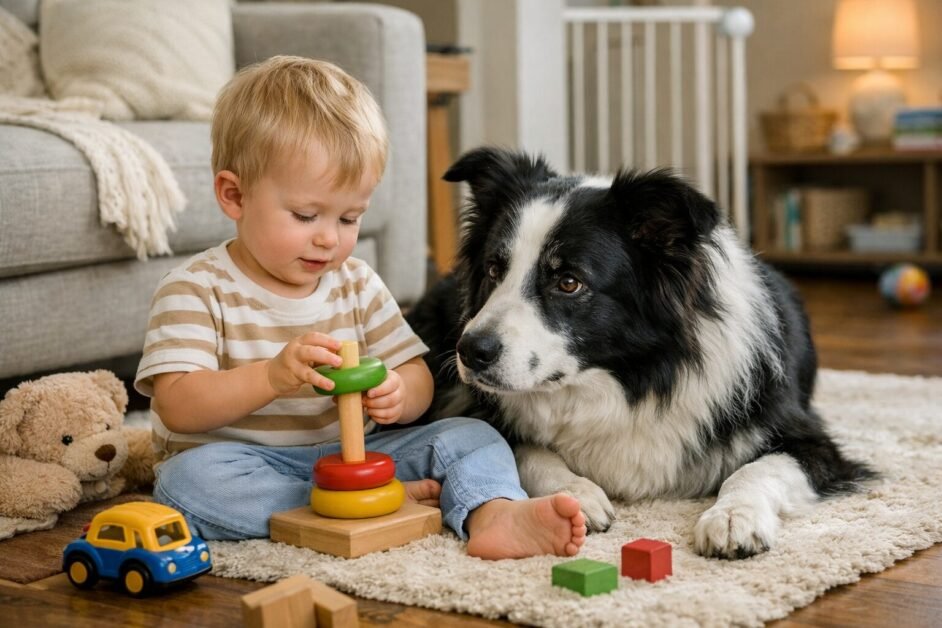
Border Collies and Toddlers: 7 Essential Safety Rules for Harmonious Living
Introduction
Border Collies and toddlers can form an incredibly sweet, loyal, and energetic bond, but managing this relationship requires a good dose of proactive planning. If you’ve spent any time around this brilliant breed, you know they are famous for their high energy and sharp intellect, often described by the American Kennel Club as having an instinct to “give eye” or move livestock. When you bring that intense drive into a home with a toddler who is constantly moving, running, and making sudden noises, it’s easy for the dog to get a little overstimulated.
The goal here isn’t to separate your best friends, but to help them coexist safely and happily. By understanding your dog’s natural instincts and teaching your little ones how to interact with respect, you can turn potential “herding” moments into a beautiful friendship. Let’s dive into the seven essential rules that will help you create a harmonious household where everyone—furry or not—feels safe and happy.
7 Essential Safety Rules for Harmonious Living
Rule 1. Never Leave Unsupervised: The Golden Rule
Even the most well-trained, obedient Border Collie can become unpredictable if they get over-excited, and toddlers are famously impulsive. This is why the most important rule is to never leave them unsupervised.
When we say “supervised,” we mean more than just being in the same house. You need to be actively present and within arm’s reach whenever your child and your dog are in the same room. A Border Collie’s high-drive nature means they might see a running, squealing toddler as something that needs to be “managed” or herded. According to The Spruce Pets, most incidents occur when a dog is reacting to an unexpected movement or when a child accidentally hurts the dog, causing a defensive reaction.
When you can’t give them your full attention—like when you’re busy cooking dinner or taking a shower—the best strategy is separation. Utilizing a sturdy baby gate or a crate creates a “safe zone” for your pup. This isn’t a punishment; it’s a necessary boundary that prevents your dog from becoming overwhelmed and helps your toddler understand that there are times when the dog needs their own space to relax. By maintaining constant supervision, you stay ahead of the game, keeping everyone calm and preventing any unwanted nipping or accidental collisions.
Rule 2. Teach the “Gentle” and “Back Off” Cues
Training is the bridge between chaotic energy and peaceful coexistence. Since Border Collies are incredibly smart and eager to learn, they pick up on commands quickly, but your toddler needs to learn some “training” too! Teaching specific cues allows you to interrupt potential problems before they escalate.
For your Border Collie:
Focus on commands that promote impulse control. “Settle” is an absolute must for this high-energy breed, as it teaches them to calm down on command. You should also teach a strong “Leave it” and a “Back off” command. The goal is to have your dog move away from the toddler immediately when you sense they are becoming too fixated or intense. The American Kennel Club provides a fantastic, step-by-step guide on mastering the “Leave it” command, which is a foundational skill for preventing your dog from becoming too obsessed with a child’s toys or erratic movements.
For your toddler:
Toddlers don’t always understand that a dog isn’t a stuffed toy. Teach your child the word “Gentle” as a cue to use soft, open-handed pets rather than grabbing or pulling at ears and tails. You can practice this using a stuffed animal first! Role-play with them: “Show me how we pet the doggie gently.” If your child gets too rough or loud, it’s your cue to calmly guide them away and give the dog a break.
The ASPCA’s guide on dogs and babies also emphasizes that preparing your dog for a toddler’s unpredictable touch is essential. By teaching these cues early, you aren’t just training a dog; you’re building a language of respect that both your toddler and your Border Collie can understand. It helps the dog realize that “Gentle” is a shared activity, and it helps the child realize that the dog has boundaries that need to be honored.
Rule 3. Respect the Dog’s “Sanctuary”
When balancing the lively energy of Border Collies and toddlers under one roof, creating a designated “safe zone” for your dog is an absolute must. Think of it as a sanctuary—a private space, like a comfortable crate or a cozy dog bed in a quiet corner of the house, where your dog can retreat when the chaos gets to be too much.
Why does this matter so much? Border Collies are bred to be highly attuned to their environment. While this makes them brilliant working dogs, it also means that a toddler’s unpredictable noises, quick movements, and constant activity can easily lead to sensory overload. When dogs become overstimulated, they are more prone to relying on their natural herding instincts or reacting defensively. Providing a sanctuary gives them a way to decompress and regulate their own nervous system.
The rule for the sanctuary is simple but strict: If the dog is in their spot, they are completely off-limits.
You will need to play “bad cop” a bit here to enforce this boundary with your child. In a fantastic guide on preparing dogs for babies and growing children, the ASPCA highlights the importance of setting up these relaxation zones and routines early. Teach your toddler that when the dog is in their bed or crate, we do not pet them, we do not call their name, and we do not throw toys to them.
Renowned dog trainers often refer to this space as the dog’s “VIP room.” According to experts featured by the American Kennel Club, you can make this space highly rewarding for the dog by keeping their favorite toys and treats in there. When your toddler learns to respect this boundary, your Border Collie will feel much more secure in the home, knowing they always have a peaceful place to go when they need a break from playtime.
Rule 4. Manage the Herding Instinct
Let’s talk about the elephant in the room—or rather, the sheepdog in the living room! Border Collies are literally born to herd. When you mix the high energy of Border Collies and toddlers, that natural herding instinct can kick into overdrive because, let’s face it, a fast-moving toddler acts a whole lot like a runaway sheep.
It’s super important to watch out for “red-flag” behaviors. If you see your dog intensely staring (often called giving “the eye”), circling your little one, or gently nipping at their heels, that’s your cue to step in. The American Kennel Club explains that this isn’t aggression; it’s simply their working DNA telling them to group the “flock” back together.
To manage this, you need to redirect that massive brain and energy before the herding behavior escalates. Keep a tug toy or a ball handy. The moment you notice that intense stare locking onto your toddler, break their focus by tossing the toy or asking for a trick.
Teaching a rock-solid redirection command is a huge game-changer here. The AKC highly recommends teaching the “Watch Me” command to grab and hold your dog’s attention. If your dog starts pacing around your toddler, saying “Watch Me” forces them to look at your face instead of the child’s feet. Combine this with a strong “Stop” or “Leave it” command, and you can effectively pause their herding drive the second it starts, replacing that intense urge with a fun, positive game of fetch or tug with you instead.
Rule 5. Structured Playtime vs. Wild Play
When it comes to Border Collies and toddlers, differentiating between wild play and structured play is a total game-changer. When your dog sees a toddler running and screaming down the hallway, their brain doesn’t just see a kid having fun—it often sees a rogue sheep that needs to be chased down and rounded up!
For your toddler, the house rule must be crystal clear: no running, shrieking, or chasing the dog. According to the American Kennel Club’s guide on helping dogs and kids coexist, letting children run and shriek can severely overexcite a dog, causing them to jump, nip, and treat the child like a littermate. The chase instinct is deeply ingrained in herding breeds, so the best way to avoid accidental knock-overs or nips is to remove the “chase” element from their interactions entirely.
Instead, focus on encouraging “calm” or structured playtime. Show your toddler how to sit quietly on the floor to engage with the dog in a controlled way. Great structured activities include gently rolling a ball back and forth, practicing simple obedience tricks (like helping the toddler tell the dog to “Sit” or “Shake” for a treat), or sitting together for a calm grooming session. By shaping the way they play, you help your Border Collie view your child as a fun, predictable partner, rather than a blurry target that needs to be herded.
Rule 6. Resource Guarding Prevention
Let’s talk about sharing—or rather, why your dog shouldn’t have to! When it comes to Border Collies and toddlers, sharing toys and snacks isn’t always a good idea. Dogs, especially smart and focused breeds like Border Collies, can sometimes develop what trainers call “resource guarding.” This simply means they become highly protective over things they value, like their food bowl, a special chew bone, or a favorite toy.
To keep everyone safe, you need to set up some strict boundaries. First, always feed your dog in a completely separate room or inside their crate. While your dog is eating, your toddler should never be allowed to approach them. The ASPCA emphasizes that preventing food guarding starts with leaving dogs entirely alone while they eat, creating a stress-free environment where they don’t feel the need to defend their meals. (By the way, if you are already crate training your Border Collie, feeding them inside the crate is a fantastic way to build positive associations with their safe space!)
Next, teach your child a simple but firm rule: if a dog’s toy is on the floor, it belongs to the dog. Toddlers shouldn’t try to take things out of the dog’s mouth or grab their bones. At the same time, you need to keep a close eye on your dog’s body language. The American Kennel Club notes that signs of resource guarding include stiffening up, freezing, giving a “whale eye” (showing the whites of their eyes), or letting out a low growl when someone gets near their stuff.
If you see any of these warning signs when your toddler approaches, that’s a clear signal to separate them, pick up the high-value items, and manage their toys much more carefully going forward.
Rule 7. Reading the Body Language Signals
When it comes to keeping the peace between Border Collies and toddlers, you essentially have to become a furry-language translator. Dogs don’t speak English, so they use their bodies to tell us exactly how they are feeling. Since your little one is way too young to pick up on these subtle clues, it’s entirely up to you to read the room.
Border Collies are highly expressive, and before a dog ever gets to the point of growling or snapping, they will almost always give off warning signs that they are uncomfortable. The American Kennel Club’s guide to reading dog body language points out several “calming signals” or signs of stress to watch for. These include lip licking (when they haven’t just eaten), yawning (when they aren’t tired), turning their head or body away from the child, and showing the whites of their eyes (often referred to as “whale eye”).
If you see your dog doing any of these things while your toddler is nearby, don’t wait to see what happens next! It means your pup is feeling overwhelmed and is trying to politely say, “I need some space, please.” Your job is to calmly step in, redirect your toddler to a new activity, and let your dog retreat to their sanctuary. By catching these early signals, you prevent accidents and build major trust, showing your dog that you always have their back.
Conclusion
Raising Border Collies and toddlers under the same roof is definitely a big adventure, but it doesn’t have to be a stressful one. By setting clear boundaries, respecting your dog’s natural instincts, and teaching your little one how to be a gentle, kind friend, you are laying the groundwork for an incredibly special bond. Remember that patience is key. There will be chaotic days, but with consistent supervision and positive reinforcement, your brilliant herding pup and your curious child can grow up to be the absolute best of friends.
Summary of Safety Rules
| Rule | Key Action | Why It Matters |
|---|---|---|
| 1. Supervise Always | Stay within arm's reach during interactions. | Prevents accidents from impulsive behavior. |
| 2. Teach Cues | Train "Gentle" for kids and "Leave it" for dogs. | Creates a shared language of respect. |
| 3. Provide Sanctuary | Give the dog an entirely off-limits bed or crate. | Prevents sensory overload and exhaustion. |
| 4. Manage Herding | Redirect staring, circling, or heel-nipping. | Stops the instinct to treat kids like runaway sheep. |
| 5. Structured Play | Enforce a strict "no running or screaming" rule. | Keeps the dog calm and prevents the chase drive. |
| 6. Prevent Guarding | Feed the dog in a completely separate room. | Stops protective behavior over food or favorite toys. |
| 7. Read Body Language | Watch for yawning, lip-licking, or whale eye. | Lets you intervene safely before a growl or snap happens. |
Frequently Asked Questions
Q. How do I quickly stop my Border Collie from herding my toddler?
A. The trick is to interrupt the behavior before it fully starts. Redirect their focus the second you see them intensely staring or circling. Use a command like "Watch Me" or "Leave It," and immediately offer a highly rewarding alternative, like a game of tug or fetching a ball, to channel that drive elsewhere.
Q. What should I do if my dog actually growls at my child?
A. First, stay calm and never punish the dog for growling. A growl is your dog's warning system communicating that they are highly uncomfortable. Calmly separate the dog and the toddler, assess what triggered the stress (like a toy on the floor or being woken up from a nap), and give the dog some quiet time in their sanctuary.