Can You Shave Border Collies? Understanding Their Unique Grooming Needs
Introduction to Can You Shave Border Collies
When the summer heat begins to peak, many owners find themselves asking: can you shave border collies to help them stay cool? It’s a logical question—after all, we trade our heavy sweaters for t-shirts as soon as the temperature rises. However, the anatomy of a Border Collie’s coat is far more complex than a simple winter jacket. These athletic herders possess a specialized “double coat” that acts as a sophisticated climate-control system, and taking a pair of clippers to it can have unintended, long-term consequences for their health and comfort.
According to the American Kennel Club, shaving a double-coated breed can actually interfere with their ability to regulate their body temperature, potentially leading to overheating rather than preventing it. To truly care for your Border Collie, you have to look past the thick fur and understand the biological “magic” happening underneath. Before you head to the groomer for a summer “buzz cut,” it is vital to understand why this breed’s coat is designed to stay exactly where it is.
Understanding the Border Collie Double Coat
To understand why the answer to “can you shave border collies” is almost always “no,” you first have to look at the remarkable engineering of their fur. Border Collies aren’t just “hairy”; they are double-coated. This means their coat consists of two distinct layers that work in tandem to protect them from the elements.
The Anatomy of the Coat
The Undercoat: This is the dense, soft, and “woolly” layer closest to the skin. Its primary job is insulation. In the winter, it traps body heat to keep the dog warm. In the summer, it traps a layer of cooler air against the skin, acting as a buffer against external heat.
The Topcoat (Guard Hairs): These are the longer, coarser, and more colorful hairs you see on the surface. According to Veterian Key, these hairs are water-resistant and serve as a shield against dirt, burrs, and, most importantly, harmful UV rays.
The “Thermostat” Effect
A common misconception is that a thick coat works like a heavy parka that only retains heat. In reality, a well-maintained double coat functions more like the insulation in a house. Just as insulation keeps a home warm in January and cool in July, the Border Collie’s coat prevents the sun’s radiant heat from reaching the skin. When you remove this layer, you aren’t “unzipping” a jacket; you are removing the home’s air conditioning buffer.
The Shedding Cycle: “Blowing the Coat”
Border Collies undergo a process known as “blowing the coat” usually twice a year—once in the spring and once in the fall. During this time, the undercoat releases in large clumps to make room for a new layer suited for the upcoming season. As noted by Rover, this heavy seasonal shedding is the dog’s natural way of thinning out its “insulation” for the summer months, making a shave completely unnecessary.
Why Shaving a Border Collie Does More Harm Than Good
While it may seem like you are doing your dog a favor by removing their heavy “fur coat,” shaving a double-coated breed like the Border Collie can lead to serious health and physical complications. Because their fur is integrated into their biological cooling system, removing it causes a systemic breakdown of their natural defenses.
Destruction of Natural Insulation
As we established, the coat acts as a thermal barrier. Without it, your Border Collie loses its ability to regulate its core temperature. Instead of staying cool, the dog’s skin is now directly exposed to the ambient heat. This can lead to rapid overheating and a significantly higher risk of heat exhaustion, as the skin absorbs the sun’s energy rather than reflecting it.
Sunburn and Skin Cancer Risks
Border Collies often have very pale, sensitive skin beneath those dark guard hairs. When you shave them, you expose that skin to intense UV radiation. Just like humans, dogs can suffer from painful sunburns. Repeated sun exposure on shaved skin can lead to more serious conditions, including solar dermatitis and various forms of skin cancer like squamous cell carcinoma.
Permanent Coat Damage (Clipper Alopecia)
One of the most frustrating consequences of shaving is that the fur may never grow back the same. This is often referred to as Clipper Alopecia or “Post-clipping Alopecia.”
Patchy Regrowth: The soft undercoat often grows back faster than the guard hairs, leading to a “fuzzy,” unkempt appearance.
Texture Changes: The new coat often feels “sticky” or coarse, making it even more prone to matting and tangling than the original coat.
Color Fading: The topcoat provides the vibrant color; when the undercoat dominates the regrowth, the dog’s coat can look dull or faded.
The “Velcro” Effect and Skin Irritation
Without the long, smooth guard hairs to repel debris, a shaved Border Collie’s regrowing fur acts like Velcro. It will trap every burr, twig, and blade of grass, leading to intense itching and skin irritation. Furthermore, they lose their natural defense against biting insects like mosquitoes and flies, which can now easily reach the skin. The VCA Animal Hospitals warn that fly strike and other pest-related irritations are much more common in dogs with compromised or shaved coats.
When Shaving is Actually Necessary (The Exceptions)
While the general rule is to avoid the clippers, there are specific, rare circumstances where shaving a Border Collie becomes a medical necessity. In these cases, the benefits of removing the fur outweigh the potential risks to the coat’s long-term health.
Severe Matting and “Pelting”
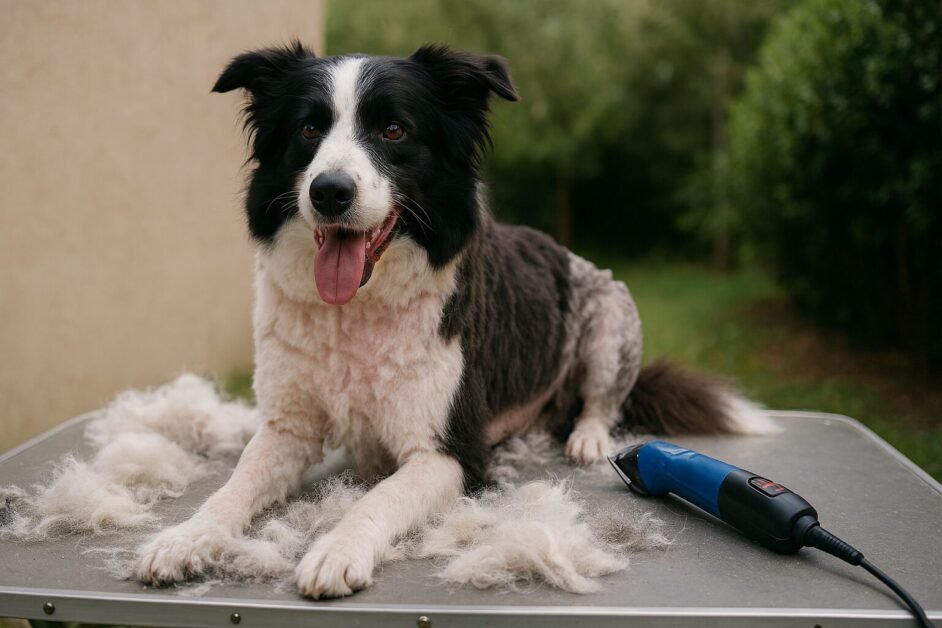
If a Border Collie’s grooming has been neglected, the undercoat can become so tangled that it forms “pelts”—thick, hard mats that sit tight against the skin. These mats are painful, pulling on the skin with every movement and trapping moisture that leads to infection. According to Rover, when a coat is “unsalvageable” due to extreme matting, a professional shave is the most humane way to relieve the dog’s discomfort and allow healthy fur to grow back.
Medical Procedures and Surgery
Before any surgical procedure, a veterinarian must shave the area to create a sterile field and prevent post-operative infections. Similarly, if your dog has a deep wound, shaving allows for proper cleaning and monitoring. VCA Animal Hospitals explains that for “hot spots” (acute moist dermatitis), clipping the hair away from the lesion is a vital first step to allow the wound to dry and heal.
Senior Dogs and Hygiene Needs
Older Border Collies with mobility issues or incontinence may benefit from a “Sanitary Clip.” This is a targeted trim—not a full-body shave—around the underside and base of the tail to prevent urine scalding or fecal matter from trapping in the long “feathers.” This measure is essential for maintaining the skin health of senior pets.
Extreme Parasite Infestations
In rare, extreme cases where the coat is too dense to effectively treat or manually inspect the skin for pests, a veterinarian might recommend a short clip. As detailed by the Whole Dog Journal, shaving can be a last-resort measure for managing severe skin conditions or health issues that prevent normal grooming.
Better Alternatives to Shaving
Since the answer to “can you shave border collies” is almost always “no” for temperature control, you might wonder how to manage that mountain of fur. The goal isn’t to remove the hair, but to maximize its efficiency. By focusing on the undercoat rather than the topcoat, you can keep your dog cool without destroying their natural protection.
Use an Undercoat Rake
The most effective way to help a Border Collie stay cool is to remove the “dead” undercoat that traps heat. Unlike a regular brush, an undercoat rake reaches beneath the guard hairs to pull out loose, fuzzy fur. According to the American Kennel Club, this process allows air to circulate against the skin, which is the key to natural cooling.
The High-Velocity “Blow Out”
Professional groomers use high-velocity dryers to “blast” loose fur out of the coat after a bath. This is often more effective than hours of brushing because the air pressure forces the shedding hair out from the root. As noted by Groomer to Groomer, a high-velocity blowout is the single most important deshedding tool for double-coated breeds, as it separates the hair fibers and prevents the undercoat from compacting into a heat-trapping wall.
Frequent Brushing Sessions
Consistency is key to managing a Border Collie’s coat. A 15-minute daily brushing session prevents the undercoat from matting. When the undercoat is “compacted,” it acts like a thick wool sweater that blocks all airflow. By keeping the hair separated, you allow the dog’s natural cooling system to work as intended. Wag! recommends working in sections and using light, even strokes to avoid irritating the skin.
Deshedding Treatments
Many professional groomers offer specialized “Low-Shed” treatments. These involve using shampoos and conditioners designed to hydrate the skin and help the undercoat release more easily during the bath. This is a safe, clipper-free way to reduce the bulk of a heavy coat while leaving the protective topcoat intact.
Summer Safety Tips (Without the Shave)
Since the double coat actually helps insulate your dog against the heat, the best way to support your Border Collie isn’t to remove their fur, but to change their environment and routine. Keeping a high-energy herding breed safe in the sun requires a proactive approach to scheduling and hydration.
Strategic Exercise Timing
Border Collies are notoriously “driven” dogs that often ignore their own thirst or fatigue to finish a job or a game of fetch. During the summer, it is vital to restrict their high-intensity exercise to the coolest parts of the day. The Cornell University Riney Canine Health Center recommends planning walks and training sessions for early morning or late evening, as the day is often hottest in the late afternoon (between 3:00 PM and 5:00 PM).
The “Five-Second” Pavement Rule
Before heading out for a walk, place the back of your hand on the pavement for five seconds. If it is too hot for you to hold it there comfortably, it is definitely too hot for your Border Collie’s paw pads. According to Washington State University Veterinary Teaching Hospital, asphalt and concrete can be considerably hotter than the air temperature, leading to deep thermal burns and chronic pain. On hot days, stick to grassy paths or shaded woodland trails.
Constant Hydration and Shade
Your dog must have access to fresh, cool water at all times. If your Border Collie spends any time in the yard, they must have access to deep, breathable shade—such as under a tree or a tarp—rather than a plastic dog house, which can trap heat like an oven. Adding ice cubes to their water bowl is a simple and effective way to encourage them to drink more and keep their core temperature stable.
Utilize Cooling Accessories
Instead of shaving, you can use external cooling tools that work with the coat’s natural properties:
Cooling Mats: Pressure-activated gel mats provide a cold surface for the dog to lie on, helping to dissipate heat from the belly.
Cooling Vests: These vests use evaporation to draw heat away from the body without soaking the undercoat.
Kiddie Pools: A shallow pool in the shade allows your Border Collie to cool their paws and underside—the specific areas where they dissipate heat most effectively.
Watch for Signs of Heatstroke
Recognizing the early warning signs of heatstroke can be a life-saving skill. Because dogs rely on panting to cool down, they are much more susceptible to heat-related illness than humans. According to PetMD, you should watch for excessive, heavy panting, bright red or purple gums, extreme lethargy, or a rapid heart rate. If you see these signs, move your dog to a cool area and contact a veterinarian immediately.
Conclusion
So, can you shave border collies? While it may seem like a shortcut to summer comfort, the science shows that their double coat is actually their most efficient cooling tool. By preserving those two layers, you are protecting your dog from sunburn, heatstroke, and permanent coat damage. Instead of reaching for the clippers, focus on a consistent grooming routine that removes the dead undercoat while leaving the protective guard hairs intact. With proper hydration, strategic exercise, and a bit of extra brushing, your Border Collie will stay cool, comfortable, and beautiful all summer long.
Frequently Asked Questions
Q. Will a Border Collie’s hair grow back if I’ve already shaved it?
A. In most cases, it will grow back, but it often takes a long time and may not return to its original texture. The undercoat typically grows faster than the topcoat, which can result in a "fuzzy" or patchy appearance for several months. In some senior dogs or those with underlying health issues, "clipper alopecia" can occur, where the hair fails to grow back properly at all.
Q. How often should I brush my Border Collie in the summer?
A. During the peak shedding seasons (spring and fall), daily brushing is ideal to remove the loose undercoat. During the rest of the summer, a thorough brushing 2–3 times a week is usually sufficient to prevent mats and maintain airflow through the coat.
Q. My Border Collie has a “summer cut”—is that the same as shaving?
A. Not necessarily. A "summer cut" or "tidy trim" usually involves using thinning shears or a longer guard on clippers to shorten the "feathers" (the long hair on the legs, tail, and belly). As long as the undercoat is not shaved down to the skin, a light trim for hygiene is generally safe.
Q. Can I use human sunblock on my Border Collie’s skin if they are thin-haired?
A. No. You should never use human sunscreen on dogs as it often contains zinc oxide or salicylates, which are toxic if licked. Always use a sunblock specifically formulated for canines on sensitive areas like the nose or ears.
Q. Does shaving help with my dog’s shedding inside the house?
A. Shaving does not stop shedding; it just means the hair falling out will be shorter and sharper (often feeling like "needles" in upholstery). The best way to manage shedding in the house is through regular deshedding sessions with an undercoat rake.