The Ultimate Border Collie Puppy Checklist: What You Need On Day One
So, you’ve decided to bring home a Border Collie. Congratulations—and good luck. This ultimate border collie puppy checklist can help you suceed. Because ready or not, you are about to be outsmarted by a creature that has been on this planet for less than eight weeks.
Bringing home a Border Collie isn’t quite like bringing home other dogs. You haven’t just adopted a puppy; you’ve acquired a high-performance athlete with the problem-solving skills of a toddler and the energy of a nuclear power plant. According to the American Kennel Club (AKC), this breed is defined by an “intense work ethic,” which is a polite way of saying that if you don’t give them a job, they will find one—and it usually involves remodeling your baseboards or herding your children.
The reality of “Day One” can be a shock. While widely ranked as the smartest dog breed in the world, that intelligence cuts both ways. Your new puppy is learning constantly—not just when you are actively training them, but also when you are ignoring them. They are watching, calculating, and waiting for you to slip up.
Pro-Tip: Border Collies are movement-sensitive. On Day One, avoid high-pitched squealing or running away from the puppy to get them to chase you. This triggers their herding instinct immediately and can lead to nipping heels—a habit that is cute at 8 weeks but dangerous at 8 months.
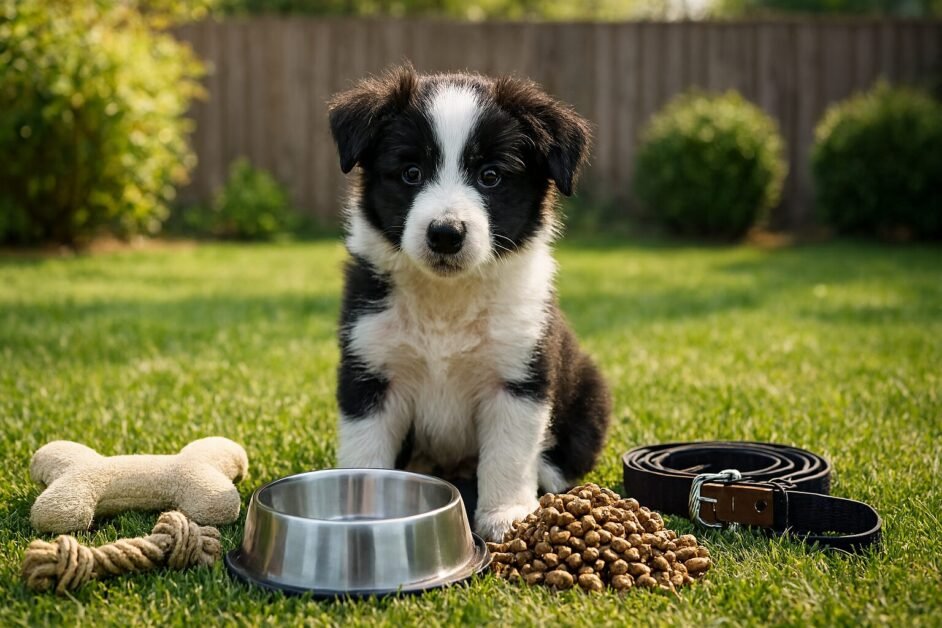
To survive the first 24 hours (and the next 15 years), you need more than just a cute leash and a bowl. You need a management strategy. This checklist is curated specifically for the unique needs of the Border Collie, focusing on mental stimulation and containment to keep your puppy safe, happy, and arguably most importantly—calm.
The “Must-Have” Management Gear (Containment)
Border Collies are active, curious, and notoriously bad at napping. If you don’t give them a job, they will find one—and that job is usually chewing your drywall or rearranging your shoe collection. Management isn’t about being mean; it’s about keeping them safe and helping them learn to relax.
The Crate (The “Off-Switch”)
This is non-negotiable for this breed. Border Collies do not naturally have an “off-switch.” They will play until they collapse or become cranky, biting land sharks. The crate is the only way to enforce the rest they desperately need to process all the new things they are learning.
Type: Get a wire crate with a divider. This allows you to buy the size they will need as an adult (approx. 36-42 inches) but shrink the interior space now so they don’t have enough room to use one corner as a bathroom.
Why it matters: Beyond potty training, the crate teaches your puppy that doing nothing is an acceptable activity.
Resource: If you are nervous about this process, read the Humane Society’s Guide to Crate Training for a step-by-step approach that avoids tears (yours and theirs).
Pro-Tip: Border Collies are visually stimulated. If your puppy barks at every movement they see through the wire crate, cover the crate with a light sheet or a dedicated crate cover. Removing the visual stimuli helps them power down their busy brains much faster.
The Exercise Pen (The “Yes Zone”)
You cannot stare at your puppy 24/7. You need to shower, cook, and check your email. The Exercise Pen (or X-Pen) is your “Yes Zone.”
Setup: Connect the X-Pen to their crate or set it up in the living room.
The Rules: Inside this pen, everything is safe. There are no electrical cords to chew and no rugs to pee on. It allows them to play and move without you hovering over them saying “No” every five seconds.
Baby Gates (The Patrol Stoppers)
Border Collies are herding dogs; they want to control space and movement. If you give them the run of the house on Day One, they will feel the need to “patrol” the entire territory, which creates anxiety.
Usage: Use gates to restrict them to one room initially (usually where the crate is).
Safety: According to the AKC’s Puppy Proofing Guide, restricting access is the easiest way to prevent ingestion of foreign objects—a common and expensive vet visit for curious herding breeds.
Mental Stimulation & Toys (The BC Special)
Here is the secret that most new owners learn the hard way: You cannot tire out a Border Collie with physical exercise alone. These dogs are bred to run 50 miles a day over sheep farms. A walk around the block won’t cut it.
To keep a Border Collie happy (and your furniture intact), you must tire out their brain. This starts on Day One.
Puzzle Toys & Slow Feeders (Ditch the Bowl)
The golden rule of Border Collie puppyhood is: Free meals are a wasted training opportunity. Instead of dumping kibble into a bowl where it disappears in 30 seconds, make them work for it.
Stuffable Rubber Toys: A hollow rubber toy stuffed with soaked kibble or peanut butter can keep a puppy occupied for 20 minutes. Freezing it extends the time even further.
Snuffle Mats: These mimic the act of foraging. You hide dry food in fabric strips, and the dog has to sniff it out. It engages their olfactory senses, which is naturally calming.
The Science: According to VCA Animal Hospitals, food puzzles provide essential environmental enrichment that can reduce stress and prevent the development of abnormal behaviors (like shadow chasing or excessive barking).
Chew Toys (The Pacifiers)
Puppies explore the world with their mouths, and teething hurts. If you don’t provide an appropriate outlet, they will choose your chair legs.
Variety is Key: Have three different textures available on Day One: one soft (rope), one medium (rubber), and one hard (nylon).
Safety Warning: Always supervise chew sessions. As noted by the ASPCA, you must remove any toy that becomes small enough to swallow or starts to break into chunks to prevent intestinal blockages.
The “Comfort” Companion
The first night away from their littermates is scary.
Heartbeat Toys: These plush toys have a battery-operated heart that mimics the vibration and sound of a mother’s heartbeat. It can be a miracle worker for reducing crate anxiety on the first night.
Pro-Tip: Border Collies are exceptionally quick learners. If you give them the same puzzle toy every day, they will master it in under a week and get bored. Create a “Toy Rotation.” Keep 5 toys in a bin and only give them 2 at a time. Swap them out every few days so they always feel “new” and exciting.
Walking & Safety Essentials
Taking a Border Collie for a walk isn’t just “exercise”—it’s a tactical mission. These dogs are movement-sensitive, lightning-fast, and prone to “spooking” at loud noises (like garbage trucks). Your gear needs to be escape-proof.
The Martingale Collar (The “No-Slip” Solution)
A standard buckle collar is often unsafe for a Border Collie puppy. Why? Because their heads are often the same width as their necks. If they panic and hit the brakes, they can back out of a standard collar in seconds.
What it is: A Martingale collar (also known as a limited-slip collar) tightens slightly when the dog pulls, preventing it from slipping over their ears, but stays loose and comfortable when the leash is slack.
Why it’s essential: It provides safety without the choking effect of old-school check chains.
The Long Line (15-30ft)
Border Collies are bred to work at a distance, but you cannot trust a puppy off-leash yet. A long line is the bridge between the two.
Usage: Use this in open fields or parks. It allows your puppy to run, sniff, and feel “free” while you maintain 100% control.
Training Benefit: It is the single best tool for teaching “Recall” (coming when called) safely.
The Leash (Standard 6ft Nylon or Leather)
Do not buy a retractable leash on Day One. While they seem convenient, veterinary professionals and trainers almost universally advise against them for powerful working breeds.
The Danger: According to PetMD, retractable leashes teach dogs to pull (because pulling extends the line) and can cause severe friction burns or neck injuries if the dog hits the end of the line at full speed.
The Fix: A standard 6ft leash gives you immediate feedback and better control if your puppy tries to herd a passing bicycle.
Pro-Tip: The “Decompression Walk.” Border Collies are easily overstimulated by city streets. Once a week, take your puppy to a quiet nature spot on a long line and let them sniff everything. Sniffing lowers a dog’s heart rate and tires them out faster than running does.
Identification (The Safety Net)
Even if your puppy is microchipped, they need a visible tag.
The Stats: The ASPCA notes that while many pets are microchipped, a visible ID tag is the fastest way for a neighbor to return your dog without needing a scanner.
What to include: Pet’s name, YOUR phone number, and the word “Microchipped.”
Nutrition & Cleanup
You are about to be responsible for a very fast metabolism. Border Collies burn energy quickly, and what goes in must come out. This section is about preventing tummy troubles and saving your carpets.
High-Quality Puppy Food (And the “Transition Rule”)
Your puppy will likely arrive with a small bag of whatever the breeder was feeding them.
The Rule: Do not switch foods cold turkey on Day One. The stress of moving to a new home combined with a sudden diet change is a guaranteed recipe for diarrhea.
The Schedule: The American Kennel Club (AKC) recommends a 5-7 day transition period. Start with 25% new food mixed with 75% old food, and gradually flip the ratio over the week.
High-Value Training Treats (The “Paycheck”)
Border Collies are working dogs. Think of treats as their currency.
The Hierarchy:
Kibble (Minimum Wage): Good for easy tricks in the living room.
Freeze-Dried Liver/Cheese (The Bonus): Essential for “Day One” potty training and recall.
Why it matters: If you try to teach a Border Collie to come when called using a piece of dry kibble while a squirrel is running by, you will lose. You need “high-value” rewards to compete with the exciting environment.
Pro-Tip: Ditch the Bowl. Take your puppy’s daily ration of kibble and put it in a treat pouch on your belt. Throughout the day, use that food to reward good choices (sitting, not biting, looking at you). This teaches your Border Collie that you are the source of all good things, not a ceramic bowl.
Enzymatic Cleaner (The “Reset Button”)
If you buy only one thing from this list, make it this.
The Science: Regular household cleaners (soap/vinegar) only wash away the visible mess. They do not break down the uric acid crystals in dog urine. Your Border Collie has a nose thousands of times stronger than yours; if they can still smell the urine, they will mark that spot again.
The Solution: Enzymatic cleaners use good bacteria to actually “eat” the organic matter, eliminating the scent marker completely.
Poop Bags (Buy in Bulk)
The Reality: You will go through 3-5 bags a day. Do not buy the tiny 3-pack at the checkout counter. Buy a bulk box of 900 online. You will use them all.
Grooming Basics (Desensitization)
You might look at your 8-week-old puppy’s short, fluffy coat and think, “I don’t need a brush yet.” You are wrong.
While they don’t need detangling yet, your Border Collie will eventually grow a thick, water-resistant double coat that sheds frequently. If you wait until they are 6 months old and matting to introduce a brush, you will have a wrestling match on your hands. Day One is about desensitization, not beauty.
The Slicker Brush or Pin Brush
This is the standard tool for the Border Collie coat.
The Goal: On Day One, just let them sniff the brush. Then, do one gentle stroke on their back and give them a treat. Repeat. You are teaching them that the brush = tasty snacks.
Why it matters: Border Collies are sensitive to touch. VCA Hospitals emphasizes that early handling of the coat and skin is critical so that future veterinary exams and grooming sessions aren’t traumatic.
Nail Clippers (The “Touch” Game)
Active dogs wear their nails down naturally to some degree, but they will still need trims.
The Strategy: Do not try to clip their nails on Day One. Just bring the clippers out.
The Exercise: Touch the clippers to their paw -> Give a Treat. Do not cut. Just touch.
The Reason: Many dogs develop “paw sensitivity.” By creating a positive association now, you prevent the need for sedation during nail trims later in life.
Pro-Tip: Handle the Ears and Mouth. Border Collies are prone to getting burrs in their ears and needing dental care later. Once a day, gently look inside your puppy’s ears and lift their gums to look at their teeth, followed immediately by a high-value treat. This makes future check-ups a breeze.
Puppy Shampoo (Tear-Free)
Border Collies are “wash-and-wear” dogs, but they will eventually roll in something unspeakable.
Recommendation: Have a bottle of gentle, puppy-safe shampoo on hand before you need it. You don’t want to be running to the store while your dog is covered in mud.
Caution: Avoid over-bathing, which can strip the natural oils from their weather-resistant coat.
Day One Game Plan: A Quick Timeline
You have the gear. Now, what do you actually do?
Border Collies thrive on routine. If you bring them home and let them run wild for 5 hours, you will end up with an over-stimulated, biting maniac. Use this rough timeline to survive the first 24 hours.
The Arrival (The “Boring” Entry)
Step 1: Before you go inside, take the puppy immediately to their designated potty spot. Wait. Wait some more. If they go, throw a party (treats/praise).
Step 2: Carry the puppy inside to the “Yes Zone” (X-Pen or puppy-proofed room).
Step 3: Keep the vibe calm. If the whole family is screaming with excitement, the puppy will get anxious. Let them sniff their new area quietly.
The “1 Up, 2 Down” Rule
This is the most important schedule you will ever learn.
The Problem: Border Collie puppies rarely put themselves to bed. They suffer from “FOMO” (Fear Of Missing Out). When they get tired, they don’t sleep—they get “wired” and start biting hands, pants, and furniture.
The Solution: For every 1 hour the puppy is awake and playing, they need 2 hours of enforced nap time in their crate.
The Science: According to the American Kennel Club, puppies need 18-20 hours of sleep per day to support healthy growth and brain development. If they aren’t sleeping that much, you need to help them.
The First Meal
Feed them inside their crate or X-Pen. This creates an immediate positive association: “This wire box is where the good stuff happens.”
The First Night (Survival Mode)
Location: For the first few nights, place the crate right next to your bed.
Why: Your puppy has never slept alone in their life. Hearing your breathing (and being able to stick your fingers through the grate to comfort them) helps them settle.
Potty Alarms: You will likely need to wake up once or twice. Set an alarm for 2:00 AM so you wake them up, rather than waiting for them to panic-cry.
Reaction: If they whine, take them out to potty on a leash (boring, no talking). If they don’t go, back in the crate. Do not let whining result in play time, or your smart Border Collie will train you to wake up for 3 AM play sessions.
Pro-Tip: Start a “Potty Log.” Tape a piece of paper to the fridge. Write down every time your puppy eats, drinks, sleeps, and poops. Within 48 hours, you will see a pattern (e.g., “He always has to go 15 minutes after eating”). This allows you to predict accidents before they happen.
Conclusion
Bringing home a Border Collie is not just getting a pet; it is adopting a lifestyle.
You have chosen a breed that is intense, brilliant, and demanding. There will be moments in the first few weeks when you are standing in the rain at 3:00 AM, waiting for them to pee, wondering if you made a mistake. You didn’t.
The work you put in during these first “Day One” moments—the crate training, the mental puzzles, the management—is an investment. By channeling their energy now, you are shaping a dog that will eventually be able to read your mind, catch a frisbee in mid-air, and be the most loyal adventure partner you could ask for.
Get your gear ready, take a deep breath, and enjoy the ride. It’s going to be fast.
Frequently Asked Questions (FAQ’s)
Q: My puppy keeps biting my ankles and kids. Is he aggressive?
A: No, he is a Border Collie. This is a herding breed. When things move quickly (like running children), their instinct is to nip at heels to control the movement. This is not aggression; it is genetics. You must redirect this behavior immediately using a toy and stop movement when they nip.
Q: When can I start training commands?
A: You start the second you walk in the door. Border Collies are sponges. They are learning even when you aren't "teaching." Start with simple engagement games (rewarding them for looking at your eyes) on Day One.
Q: Can I take my puppy outside before they are fully vaccinated?
A: This is a balance of risk. While you should avoid high-traffic dog parks, keeping your puppy inside until 16 weeks can lead to severe behavioral issues. You can carry them in a sling or backpack to hear traffic and see people without their paws touching the ground.